
Intro
Interior systems include the dashboard, armrest, centre console, door panel and gear shift cover. The thread is used for functional seams, decorative seams and also as a tear-away thread for dashboard airbag seams.
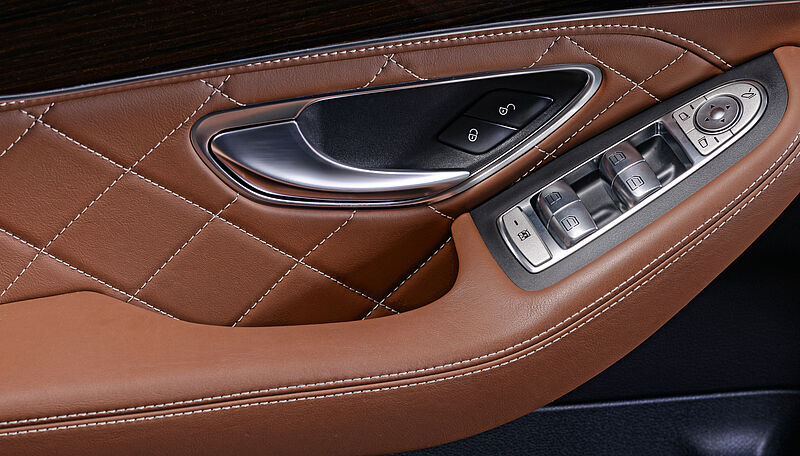
Manufacture of interior systems
Only multifilament threads are used for the manufacture of interior systems. Due to the high demands placed on the performance of sewing threads during processing and in use, the use of other types of thread is out of the question.
The following sewing threads from the AMANN range are recommended for interior components:
| Type of seam | Product recommendation |
|---|---|
| Decorative seams | Serafil, polyester continuous filament, unbonded Ticket 15, 20 as needle thread Ticket 25, 30, 40 as bobbin thread Strongfil+, polyamide 6.6 continuous filament thread, unbonded Ticket 40 as bobbin thread |
| Functional seams | Serafil, polyester continuous filament, unbonded Ticket 25, 30, 40 as needle/bobbin thread Strongfil+, polyamide 6.6 continuous filament, unbonded Ticket 40 as needle/bobbin thread |
| Dashboard deployment seams | Serafil, polyester continuous filament, unbonded Ticket 120 as needle/bobbin thread |
It is possible to combine different types of tickets and sewing thread, but the minimum requirements described in the chapter on seating systems must be observed.
Normally, for decorative seams, the bobbin thread is twice the thread count or half the fineness of the needle thread (e.g. Serafil 20 as the upper thread and Serafil 40 as the bobbin thread). For functional seams, threads of the same ticket are used (e.g. Serafil 40 as both the upper and bobbin threads). For dashboard tear-away seams, Serafil 120 is used as both the upper and lower thread. Serafil 120 has also been the benchmark product for this safety-critical application for many years and meets all automotive requirements regarding documentation and process capability. As already mentioned, the traceability of production data is ensured by the special marking using a barcode label on the bobbin base. The sewing parameters to be used are precisely defined by the OEM and must be strictly adhered to.
Requirements and characteristics
Particularly when it comes to interior components, the focus is on perfect decorative seams. Contrast threads are often used. Every stitch is visible and must be perfectly positioned. This can be reliably achieved using high-quality sewing threads from AMANN in conjunction with optimal sewing parameters. The excellent glide, balanced twist ratio and very good feed properties of Serafil and Strongfil+ form the basis for a flawless sewing process with high process stability and a low scrap rate.
Polyester sewing threads are the best choice for decorative seams on interior components; Serafil stands out for its excellent heat and light fastness, making it ideal for use in parts exposed to particularly high levels of UV radiation. The product’s highly balanced quality profile enables extremely precise workmanship, particularly when working with thin fabrics, as is common in interior applications. A key factor here is the excellent glide, which is due to the high-quality finishing of the sewing thread.
Polyamide sewing threads are used as bobbin threads for safe functional seams, but only in ticket 40. Due to their lower lightfastness, which is attributable to the raw materials used, Strongfil+ is not recommended for decorative seams on parts exposed to high levels of UV radiation.
Needle point:
For decorative stitching on leather/faux leather: cutting points (LR, S, LL, D, DH or SD/SD1); these ensure sufficient thread take-in and precise seams.
For decorative seams on fabric or knitted/woven fabrics: round or ball points (R, FFG/SES); cutting points damage the fabric.
For closing seams on leather/imitation leather: round points (R)
Stitch type:
The standard stitch is the double lockstitch (type 301), available in 1-needle or 2-needle versions; for stitching slush-skin dashboards or door panels, the double chainstitch (type 401) is also available
Machines:
Double lockstitch sewing machines for medium-duty applications (decorative and closing seams), 3D sewing machine (decorative seams on three-dimensional slush-skin components), sewing stations for documented sewing of airbag tearing seams (side-airbag deployment seam)
Stitch density:
Decorative seams: between 2 – 2.5 stitches/cm
Functional seams: between 3 – 4 stitches/cm
Dashboard deployment seams: according to OEM specification
Special processing recommendations for interior systems
Christmas tree effext / S- and Z-twisted seams
The so-called ‘Christmas tree effect’ in 2-needle decorative seams (where the stitches on the right-hand needle side are at an angle) is caused by the opposite threading direction and loop pick-up on the right and left needle sides. There is potential for improvement with leather/faux leather by using a suitable cutting point (S or LL), increasing the material thickness with a seam tape, or using a thinner bobbin thread (e.g. Serafil 40 instead of Serafil 20). The use of S-twisted threads on the left needle offers no technical advantage, as the seam is perceived as more uneven due to the different twist direction.
Strongfil+ is not recommended for decorative seams on parts exposed to high levels of UV radiation.


Untwisted needle thread with decorative seams on artificial leather
Artificial or faux leather is often difficult to work with, as the elasticity of the material generates high friction during sewing, which can cause the needle thread to twist. Possible measures to improve workability include:
- Thorough inspection of the machine
- Fine polishing of the sewing components (in particular the feed dog, needle plate and looper; polish in the direction of thread withdrawal)
- Use of a suitable needle size
- Testing of a sample seam
- Reduction of the sewing speed
If this is not sufficient, the artificial leather can be optimised for better processability.

FAQ
-
Interior systems include components such as door panels, dashboards, and trims. These elements combine functionality and design.
-
Seams must provide sufficient strength while maintaining a high-quality appearance. They often serve decorative and functional purposes.
-
They are typically exposed to less mechanical stress than seats. However, they must still withstand environmental conditions.
-
Interior components are exposed to sunlight over time. UV resistance prevents fading and material degradation.
-
Seam design is a key visual element in automotive interiors. It contributes to the overall look and perceived quality.
-
Threads must match both functional and visual requirements. They must ensure durability while supporting design intent.
-
Yes, temperature fluctuations can stress materials and seams. Threads must maintain stability under these conditions.
-
Consistent seam quality ensures uniform appearance across all components. This is essential for OEM standards.