
Intro
Seating systems include seat covers, headrests and side bolsters. For decades, thread has been used in all these components as an indispensable binding element for functional seams, as well as an attractive decorative feature. Seating comfort plays just as important a role in the component as the attractive appearance of the decorative seams. Both criteria can only be optimally met through the use of high-quality sewing threads and the correct sewing parameters. A special feature in seat cover production is the side-airbag deployment seam.
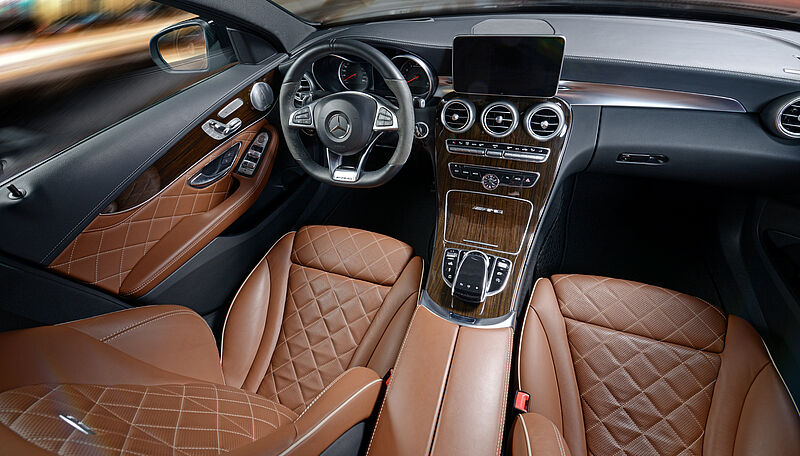
Manufacture of covers for seats and headrests
Multifilament yarns are used almost exclusively for seat and headrest covers. Due to the high demands placed on the sewing thread’s performance during the sewing process and in the subsequent use of the component, the use of other types of sewing thread is generally out of the question.
The following sewing threads from the AMANN range are recommended for seating systems:
| Type of seam | Product recommendation |
|---|---|
| Decorative seams | Serafil, polyester continuous filament, unbonded Strongfil, polyamide 6.6 continuous filament, unbonded Ticket 13 as needle thread Ticket 30, 40 as bobbin thread Strongfil+, polyamide 6.6 continuous filament, unbonded Ticket 20, 30 as needle/bobbin thread |
| Functional seams | Serafil, polyester continuous filament, unbonded Ticket 25, 30 as needle/bobbin thread Strongfil+, polyamide 6.6 continuous filament, unbonded Ticket 30, 40 as needle/bobbin thread |
| Side-airbag deployment seams | Serafil, polyester continuous filament, unbonded Ticket 40 as needle thread Ticket 80 as bobbin thread Strongfil+, polyamide 6.6 continuous filament, unbonded Ticket 40 as bobbin thread |
| Embroidery | Isacord, polyester continuous filament, unbonded, trilobal Ticket 40 as needle thread Serafil, polyester continuous filament, unbonded Ticket 80, 120/3 as needle thread Isa polyester fibre thread, unbonded Ticket 150 as bobbin thread |
It is possible to combine different types of tickets and sewing thread. However, the following minimum requirements must be observed.
For decorative seams, the bobbin thread must be chosen to match the needle thread. Normally, the bobbin thread should be twice the ticket number or half the thickness of the needle thread; for example, a needle thread of ticket 20 should be combined with a bobbin thread of ticket 40. Extreme differences in fineness, such as needle thread 20 with bobbin thread 80 or needle thread 20 with bobbin thread 15, should be avoided. Polyester and polyamide sewing threads can generally be combined in a single seam system.
For functional seams, the same ticket size is used for both the needle and the bobbin thread. Other combinations are uncommon and offer no technical advantage. The exception is the side-airbag deployment seam.
For the side-airbag deployment seam, ticket 40 is typically used as the needle thread in combination with ticket 80 as the bobbin thread. For decades, Serafil 80 has been the benchmark product for this safety-critical application and meets all automotive requirements regarding documentation and processability. The traceability of production data is ensured by a special marking using a barcode label on the bobbin foot. The sewing parameters to be used are precisely defined by the OEM (Original Equipment Manufacturer) and must be strictly adhered to.
Isacord is predominantly used for embroidery on headrests or front seatbacks (only in the shoulder area); Serafil 80 and 120 are also suitable for embroidery. The thread for the finest lines with a width of < 1.5 mm or lettering/symbols < 2 mm is Serafil fine 180 (120/2). Isa 150 is recommended as the bobbin thread for embroidery on leather, artificial leather, fabric and floor mats; the combination of the slightly hairy Isa 150 staple fibre thread with a smooth needle thread is the solution for reliable embroidery. The use of Isacord 40 on automotive seat surfaces (front or rear seats, high-stress areas) is strongly discouraged in all cases. In general, the abrasion resistance requirements for the specific application must be observed.
Requirements and features
Due to their raw materials, polyester sewing threads such as Serafil offer excellent heat and light fastness, as well as a wide range of possibilities for automotive colour design. Furthermore, their mechanical properties meet all automotive requirements. Serafil’s highly balanced quality profile enables extremely precise processing, with the thread’s excellent gliding properties being a key factor. In particular, outstanding seam results with high process reliability can be achieved when performing demanding stitching on seat centre panels.
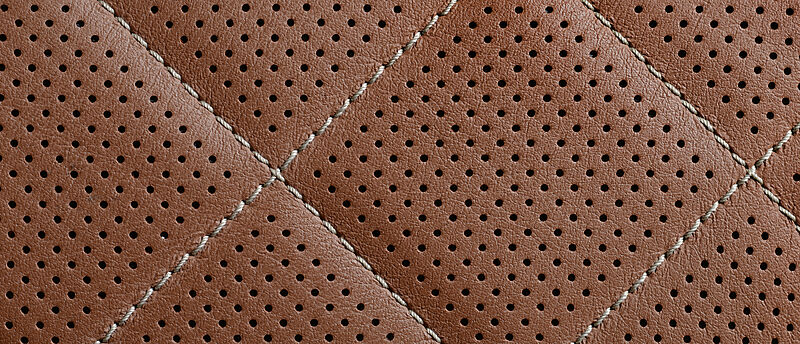
Our Strongfil+ polyamide sewing thread is particularly notable for its excellent mechanical properties. Its heat fastness and dye-taking properties are good, though they are somewhat limited compared to polyester due to the nature of the raw material.
Both Serafil and Strongfil+ are equally suitable for the manufacture of seat covers, although the different properties of the polymers must be taken into account during seat design.
Key processing parameters
Needle size: Nm 110–180 - The minimum needle size required depends on the visible thread diameter (the thread must have sufficient clearance in the eye of the needle), as well as on the fabric and the number of layers. We recommend carrying out sufficient tests using the actual material under production conditions or conditions similar to those in production. The recommended needle sizes for each product are listed on the relevant product pages.
Needle point: For decorative seams on leather or imitation leather: cutting points (LR, S, LL, D, DH or SD/SD1), which ensure sufficient thread take-in and precise stitching.
For decorative seams on fabric or knitted fabrics: use round or ball-point needles (R, FFG/SES); sharp-pointed needles will damage the fabric.
For closing seams on leather/faux leather: round points (R); for very hard/thick leather, also a small cutting point (SD/SD1)
Stitch type: The standard stitch is the double lockstitch (type 301), available in 1-needle or 2-needle versions; in some cases, the double chainstitch (type 401) is also used for stitching centre panels, as well as the overlock stitch (types 504 and 505) for headrests
Machines: Double-needle lockstitch sewing machines for medium-duty/heavy-duty applications (decorative and closing seams), automatic sewing machines (large-area quilting/diamond quilting), workstations for the documented sewing of airbag tear seams (side-airbag deployment seam), overlock sewing machines (headrest edging)
Stitch density:
Decorative seams: between 2 – 2.5 stitches/cm
Functional seams: between 2.5 – 3.3 stitches/cm
Side-airbag deployment seams: according to OEM specification
Overlock seams: between 5 – 6.5 stitches/cm
Special processing instructions
1. Knot effect
Knots on the underside of decorative or closing seams are caused by insufficient thread take-in. This can be remedied by ensuring the thread tension is set precisely and consistently (using a measuring device), using the correct needle size and a suitable point, polishing the sewing tools on the machine, and replacing defective or excessively worn parts (particularly the needle plate and feed dog). In the case of leather with significant variations in thickness, the seam area must be levelled by sharpening.

2. Profile seams
When sewing profiles onto seat covers, the sewing thread is subjected to extreme stress. Using high-quality sewing threads can prevent many problems before they arise. Thanks to the excellent finish of AMANN sewing threads, needle temperature is significantly reduced, resulting in fewer instances of thread melting or breakage. Additional needle cooling is beneficial. For cardboard profiles that are very difficult to process, Rasant-Oxella 20 or 25 may be a suitable alternative to multifilament threads such as Serafil 20, 30 or Strongfil+ 20, 30, 40.

3. Thread guidance and thread tension adjustment
To avoid sewing problems from the outset, it is very important to follow the sewing machine manufacturer’s instructions on correct threading. It is recommended that a thread tension gauge is used to set the thread tension; this is the only way to ensure that the adjustment is precise and reproducible. The needle thread tension is measured at the top dead centre of the thread lever.
As a general rule, thread tension should be set as low as possible and only as high as necessary. For double lockstitch seams, an upper thread tension of 350–450 cN works well with a size 20 needle thread, whilst a lower thread tension of 75–150 cN is suitable for a size 40 bobbin thread. Values above 600 cN for the needle thread or 200 cN for the lower thread should be avoided at all costs. Excessive thread tension can often cause problems such as thread breakage, uneven decorative seams or knots.
The appropriate setting must be determined through individual testing, as thread tension depends on many factors (including the number of layers of fabric, the type and thickness of the fabric, the type and thickness of the upper and lower threads, and the type of machine and needle).
FAQ
-
Seating systems include seat covers, cushions, and structural components. They must combine comfort, durability, and safety.
-
Seats are exposed to constant mechanical stress, friction, and movement. Seams must withstand repeated loading over time.
-
Seats are subject to continuous friction from users. High abrasion resistance ensures long-lasting seam performance.
-
Elastic threads allow seams to adapt to movement and pressure. This improves comfort and prevents seam failure.
-
Seat seams are highly visible and influence perceived quality. Clean and consistent stitching is essential.
-
Seams must maintain integrity under stress, especially in critical areas. They must meet strict safety standards.
-
Materials include leather, synthetic leather, and textiles. Each requires specific thread and sewing solutions.
-
Seats experience daily wear over long periods. Durable seams ensure long product life and customer satisfaction.