
Intro
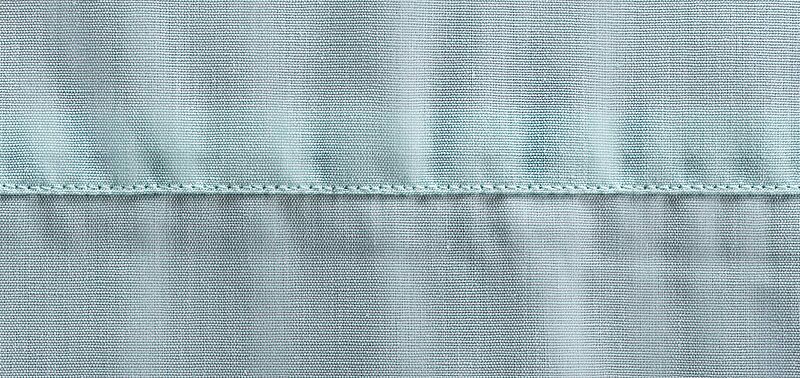
Displacement puckering is a seam appearance defect caused by the displacement of fabric yarns rather than by incorrect thread tension or fabric feeding. Recognising its characteristic appearance helps to distinguish it from other types of seam puckering and identify suitable corrective measures.
Distinguishing feature
- Puckering appears on both sides of the seam.
- The puckering remains visible even after cutting the stitch bridge.
- This indicates permanent displacement of the fabric yarns rather than temporary seam compression.
Problem
Displacement of individual warp or weft threads by the needle penetration (without sewing thread). The effect is intensified when sewing thread is used.
Explanation
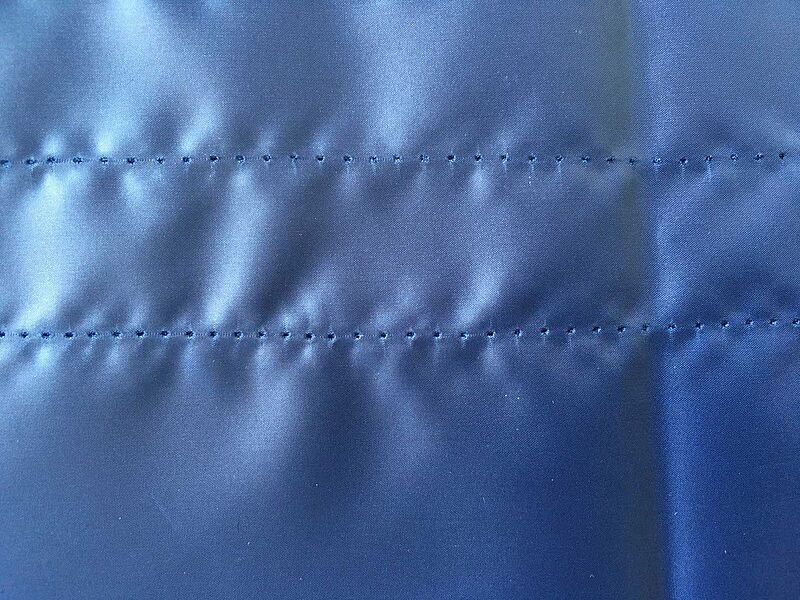
The extent of the displacement depends on various factors:
- Type of weave (plain weave fabrics generally tend to pucker more than satin or twill weave fabrics due to their structure)
- Fabric density (the denser the weave, the more prone to puckering)
- Stitch density (the more stitches, the stronger the puckering)
- Needle and sewing thread ticket (the thicker, the stronger the puckering)
- Fabric finish (highly refined fabrics, e.g. easy-care finishes, only allow limited movement of the warp or weft threads)
Displacement puckering usually cannot be completely avoided during processing. Under certain circumstances, the following suggested solutions may reduce the visual impairment to some extent.
Solution
- Use the finest sewing thread ticket possible, but suitable for the application (the use of core spuns or continuous filaments is more favourable than the use of spuns due to their smaller optical diameter and comparable tensile strength).

Select needles that are as fine as possible for the sewing thread strength (reducing the needle size by Nm 5 can already result in a visible improvement).
Use suitable needle tips and blade types (due to the different behaviour of the fabrics, carry out your own needle tests if necessary).
With the double chain stitch (stitch type 401), fewer warp and weft threads are displaced due to the seam construction (thread looping on the bottom of the fabric).

- Balanced stitch length (the fewer stitches, the less displacement; but be careful: pay attention to seam strength!)
- Rotation of the seam line by approx. 5° from the grain (slightly diagonal to the warp direction so that the fabric thread displacement is distributed over several warp and weft threads)
- Rotate the cut pattern by 90° so that the grain runs in the weft direction (the fabric thread density is usually lower in the weft direction, which means that the seam may be less prone to puckering in this direction).
FAQ
-
Displacement puckering occurs when fabric yarns are pushed aside during sewing. This creates visible distortion along the seam.
-
It is caused by needle penetration displacing fabric yarns instead of piercing them cleanly. Fabric structure is a key factor.
-
Tightly woven fabrics are particularly susceptible. Their structure makes it harder for the needle to penetrate without distortion.
-
Using the correct needle size and type helps minimize yarn displacement. Optimizing stitch density also improves results.
-
Yes, needle geometry and size are critical. The wrong needle can increase fabric distortion.
-
High stitch density increases the risk of distortion. Adjusting stitch length can help reduce the effect.
-
Yes, it often appears during sewing. It can worsen after finishing processes such as ironing.
-
Fabric density and weave determine how yarns react to needle penetration. This directly influences puckering behavior.