
Dyeing
For this production step, the threads must first be rewound onto dyeing spools. The hollow spindles are perforated to allow the dye bath to pass from the inside to the outside and vice versa. In addition, a suitable winding structure and controlled tension during rewinding are important for the subsequent dyeing result. The aim is to achieve uniform colouring of the sewing threads and embroidery threads, regardless of their position (outside or inside) on the dyeing spool.
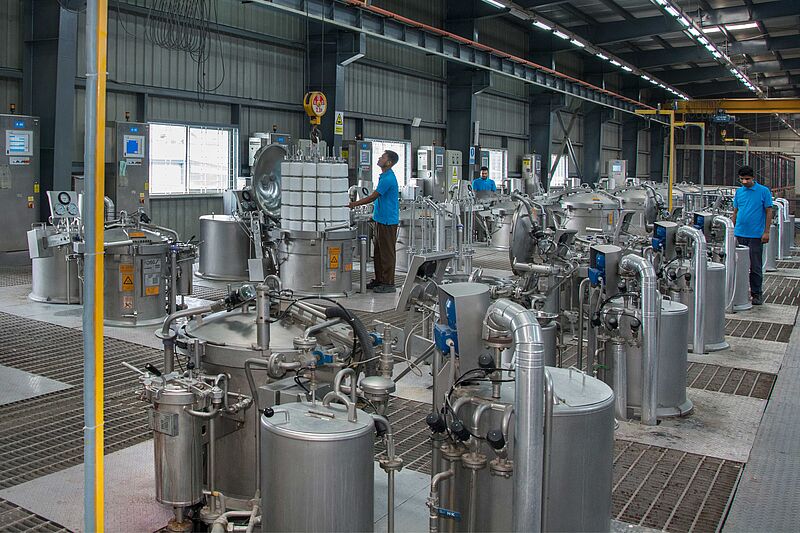
Polyester sewing threads and embroidery threads are dyed using the so-called HT (high temperature) process. Disperse dyes are used for dyeing. Important dyeing parameters are pressure, temperature and the bath liquor ratio. Dyeing takes place in a closed circuit on modern dyeing equipment. The colour formula is compiled with the aid of a computer. In the so-called mixing room, the individual dyes and dyeing auxiliaries are prepared according to exact specifications and mixed with water in dyeing kiers. The dye bath is fed through a pipe system to the individual dyeing kirtd in the dye house. These have different capacities ranging from approx. 10 to 700 kg. Polyester threads are dyed at approx. 135°C and a pressure of four to six bar for approx. 60 minutes. The colour shade achieved is checked immediately after the dyeing process so that any colour deviations can be compensated for immediately by re-dyeing. Coarser yarns sometimes have to be dyed twice to achieve optimal colour dye penetration and to avoid the occurrence of so-called undyed spots at the crossing points of the yarn.
The choice of dyeing process is primarily determined by the raw material used for the sewing thread. Cotton and polyamide, for example, require a different process than polyester. In the case of polyester/cotton core spun thread, the combination of polyester and cotton as raw materials requires two dyeing processes to be considered. In a single process, but in two consecutive steps, the polyester is dyed first, followed by the cotton.
Pure cotton yarns are often dyed in hanks and require specially designed dyeing equipment. Cotton yarns are usually dyed using reactive dyes. However, substantive and indanthrene dyes can also be used for special applications. For a small number of polyester/cotton core spun yarn dyeings, AMANN uses substantive dyes to achieve the desired used look (washed-out appearance) in the denim sector.
Optical brighteners are sometimes used to dye white, neon colours and light, delicate pastel shades. This allows UV light from the invisible spectral range to be converted into visible light and reflected. This effect gives optically brightened colours a kind of ‘luminosity’ that is particularly noticeable under black light. The brownish-yellow natural colour of raw cotton is unsuitable for such colours and must therefore be removed by bleaching beforehand.
To create a new sewing thread or embroidery thread colour, the dyeing laboratory requires a flat, non-transparent colour sample (usually a fabric sample). The sample colour is measured using a colour measuring device and displayed as a reflection curve. The dyeing recipe software calculates various recipes from the specified dyes, from which the dyer selects the best one based on quality and economic considerations. The colour yield of a recipe is first checked using a laboratory dyeing test. If necessary, the recipe is adjusted and, if it is approved, it is recorded in the colour archive and released for production.
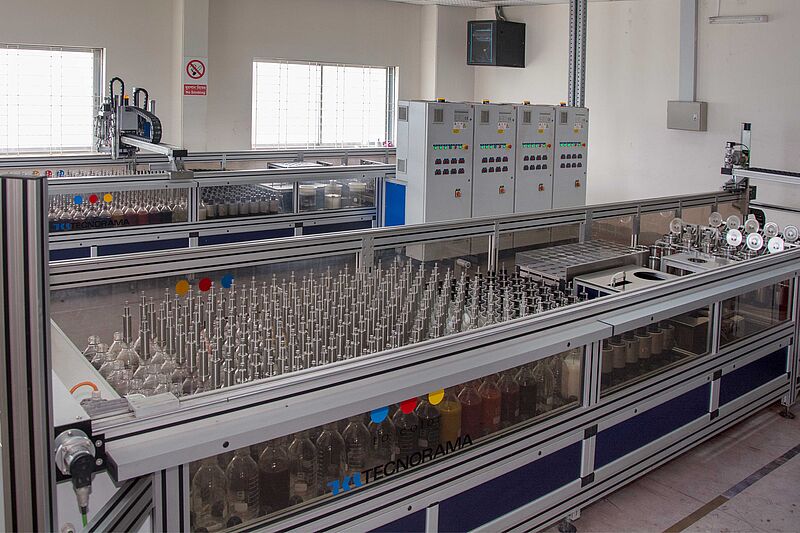
AMANN attaches particular importance to the environmental compatibility of its dye houses. Through the use of efficient systems and careful monitoring, AMANN has been able to significantly reduce its overall consumption of primary energy. Ongoing process optimisation in the dye houses has led to a considerable reduction in the consumption of fresh water and minimised the use of dyes and dyeing auxiliaries. All dye houses have a closed water cycle.
AMANN operates full-scale biological-chemical wastewater treatment plants in order to comply with local environmental regulations. Their capacity ranges from 500 to 1,000 m3 of wastewater per day. The treated wastewater is continuously monitored at the outlet into the local sewage system to ensure compliance with strict discharge parameters for BOD (biological oxygen demand), COD (chemical oxygen demand), proportion of dissolved suspended solids, pH value and temperature. In addition, samples are taken and analysed regularly by the local environmental authorities. AMANN thus makes a significant contribution to environmental protection.
FAQ
-
Dyeing gives the thread its color and visual appeal. It must be uniform and durable.
-
Threads are dyed using controlled chemical processes. This ensures even color distribution.
-
Factors include yarn cleanliness, dye process control, and material type. These influence color consistency.
-
Inconsistent color leads to visible defects in the final product. This affects quality perception.
-
Yes, improper dyeing can weaken fibers. Proper processes maintain strength.
-
Yes, dyeing methods vary depending on material and application. Each requires specific conditions.
-
Through controlled dyeing and finishing processes. This ensures resistance to washing and light.
-
Testing verifies color consistency and durability. It ensures quality standards are met.