
Intro
Twisting is the process of twisting yarns together to form a thread. The plied yarns are twisted around their longitudinal axis, thereby binding them tightly together. The twist is created by a rapidly rotating spindle. Depending on the direction of rotation of the spindle, there are S-twisted and Z-twisted yarns. The off-winding speed and spindle speed determine the number of twists in the thread. Today, the twisting process is used almost exclusively to produce direct or single-stage threads, i.e. several yarns are twisted together in a single operation. Double or multi-stage threads, which are hardly used today, require two or more successive twisting operations.
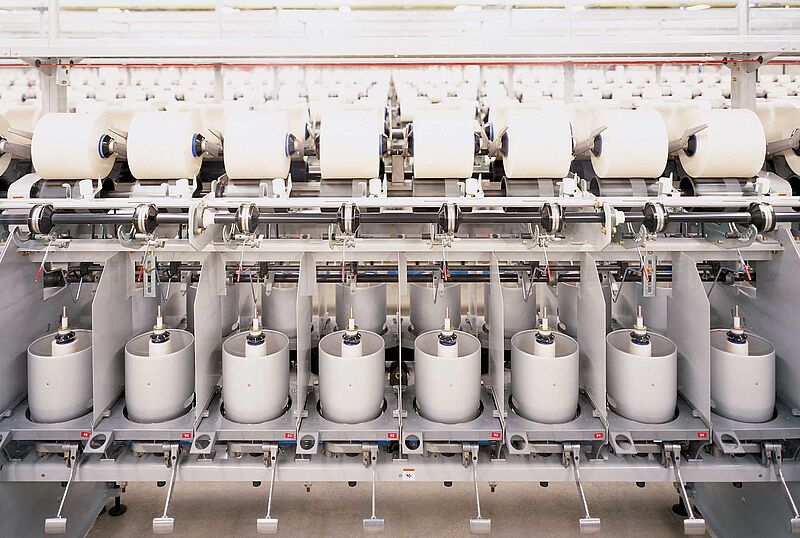
The lead times for the twisting process are very long. The finest continuous filament yarns, which are processed by the twisting machine in correspondingly large lengths, have a lead time of twelve days, for example.
Single sewing threads are also twisted in order to obtain a uniform and stable preliminary product. The term ‘“uptwisting” is more understandable here than ‘twisting’, as only one yarn is twisted around its longitudinal axis instead of connecting different yarns with each other by twisting.
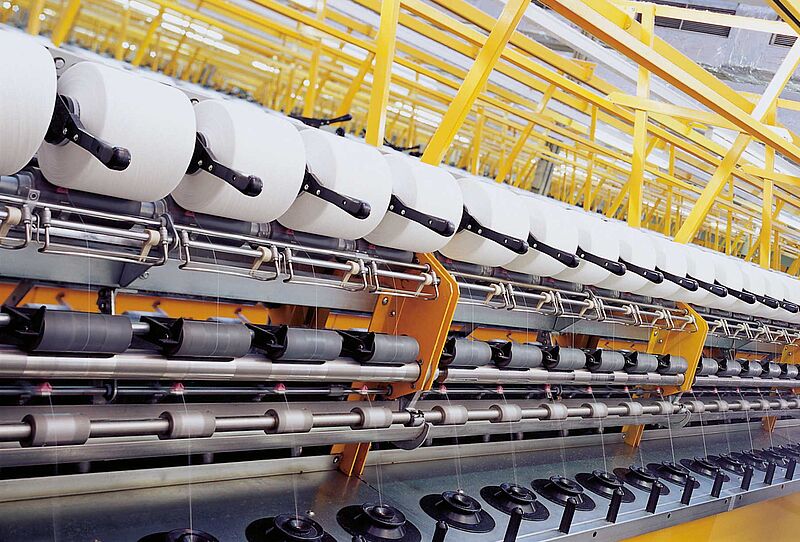
On twisting machines for continuous filament yarns, the filament threads undergo both yarn twisting and final thread twisting. Pre-wound continuous filament yarn is fed into the twisting machines, where it is first twisted in the S direction, then folded and twisted in the Z direction. This is a particularly effective manufacturing process that is mainly used for filament material.
FAQ
-
Twisting binds fibers or yarns together. It gives the thread strength and cohesion.
-
The twist level determines strength, flexibility, and appearance. Too much or too little twist can cause problems.
-
Proper twist ensures smooth sewing and reduces breakage. Incorrect twist leads to instability.
-
Yes, twist direction affects how the thread interacts with the sewing machine. It must be matched to the application.
-
The thread becomes weak and prone to splitting. This reduces durability.
-
The thread becomes stiff and less flexible. This can affect seam appearance.
-
Yes, twist levels are optimized depending on the use case. This ensures optimal performance.
-
It stabilizes the structure of the thread. Without twisting, the thread would not hold together.