Short definition
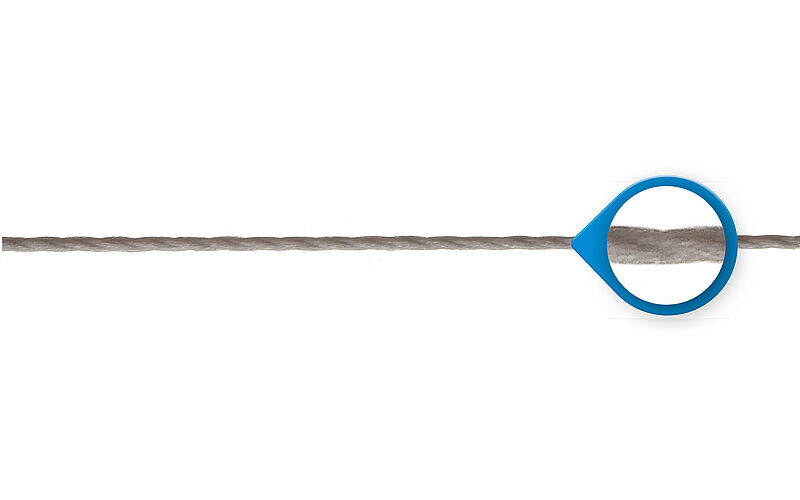
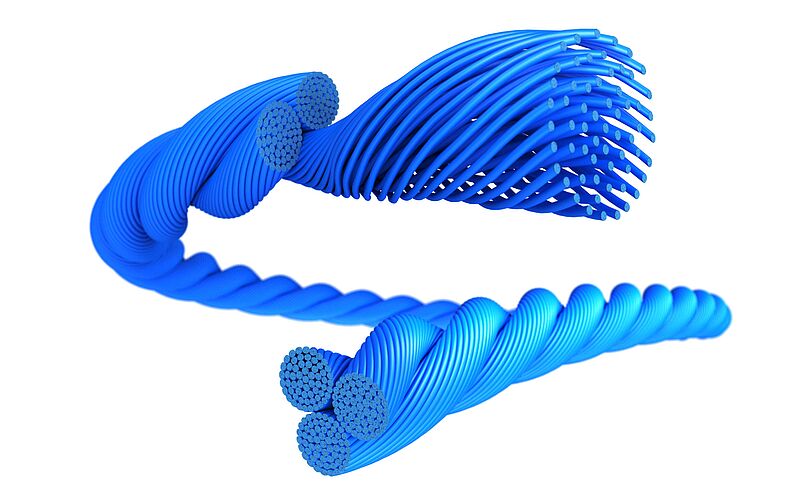
A continuous filament sewing thread consists of continuous, virtually endless filaments combined into single yarns, often as multifilaments. The construction provides a smooth, shiny surface together with very high tear and abrasion resistance, making it particularly suitable for demanding and technical applications.
Well-known AMANN products include Serafil (polyester continuous filament) and Onyx (polyamide continuous filament), as well as Nc-tech, Kc-tech, C-tech, I-tech and Zyex in the Techtex range.
In the clothing sector, only the finest thicknesses are generally used. The main areas of application are overlock seams for cut edges and blindstitch seams.
In the field of embroidery threads in particular, the classic construction type is continuous filament made from trilobal polyester. The trilobal filament shape increases the light-reflecting surface area of the material and ensures the impressive, important shine of embroidery.
Quick facts
| Property | Value |
|---|---|
| Category | Sewing thread construction |
| Construction principle | Continuous filaments combined into yarn |
| Typical form | Multifilament |
| Filaments per yarn | In some cases up to approx. 200 |
| Main raw materials | Polyester, polyamide |
| Technical raw materials | Aramid, polyethylene, PTT, polypropylene, PEEK |
| Surface | Smooth, shiny, uniform |
| Key properties | Very high tear resistance and abrasion resistance |
| Typical applications | Footwear, accessories, home interiors, technical textiles |
| Embroidery | Trilobal polyester filament is a classic embroidery construction |
AMANN notes that coarser continuous filament threads are generally 3-ply, while finer qualities are predominantly 2-ply.
Also known as
Technical terms
- Continuous filament
- Continuous filament thread
- Continuous filament sewing thread
- Filament thread
- Multifilament thread
- Multifilament sewing thread
- Continuous filament yarn
- Multifilament yarn
Common descriptions
People often search for:
- Endless filament thread
- Smooth sewing thread
- Shiny sewing thread
- High-strength filament thread
- Polyester filament thread
- Polyamide filament thread
- What is continuous filament thread?
- What is multifilament thread?
- Why is filament thread stronger?
- Which thread has a smooth surface?
Alternative terminology
Different industries and software providers may use slightly different terminology.
- Filament sewing thread
- Endless filament yarn
- Smooth filament thread
- Continuous multifilament
- Multifilament construction
International terminology
| Language | Common terminology |
|---|---|
| English | Continuous filament, Continuous filament thread, Filament thread, Multifilament thread |
| German | Endlosfilament, Filamentgarn, Multifilamentgarn, Nähgarn aus Endlosfilamenten |
| French | Fil à filaments continus, Fil continu, Fil multifilament |
| Italian | Filo a filamento continuo, Filato continuo, Filato multifilamento |
| Spanish | Hilo de filamento continuo, Filamento continuo, Hilo multifilamento |
| Chinese | 长丝缝纫线, 连续长丝, 复丝缝纫线, 长丝纱 |
| Vietnamese | Chỉ filament liên tục, Chỉ sợi dài liên tục, Chỉ multifilament |
FAQ
-
A continuous filament thread consists of endless fibres (filaments). These filaments are combined to form a single yarn, often as a multifilament construction.
-
A multifilament yarn is made up of many individual continuous filaments — in some cases up to 200 — bundled together to form a single yarn.
-
Common raw materials include polyester and polyamide. For technical applications, aramids, polyethylene, polytrimethylene terephthalate, polypropylene and PEEK may also be used.
-
Because they consist of uninterrupted filaments, they offer very high tear resistance and abrasion resistance compared to staple fibre constructions.
-
Continuous filament threads have a smooth, shiny surface and a uniform twisted character.
-
Coarser thicknesses are typically 3-ply constructions, while finer qualities are usually 2-ply constructions.
-
They are widely used in footwear, leather goods, accessories, home interiors and technical textiles.
-
Yes, but generally only in finer thicknesses. Typical applications include overlock seams for cut edges and blindstitch seams.
-
In embroidery, trilobal polyester continuous filaments are commonly used. The trilobal cross-section increases light reflection and creates a high-gloss effect.
-
Key advantages include high strength, excellent abrasion resistance, smooth surface, uniform appearance and reliable sewing performance.