
Short definition
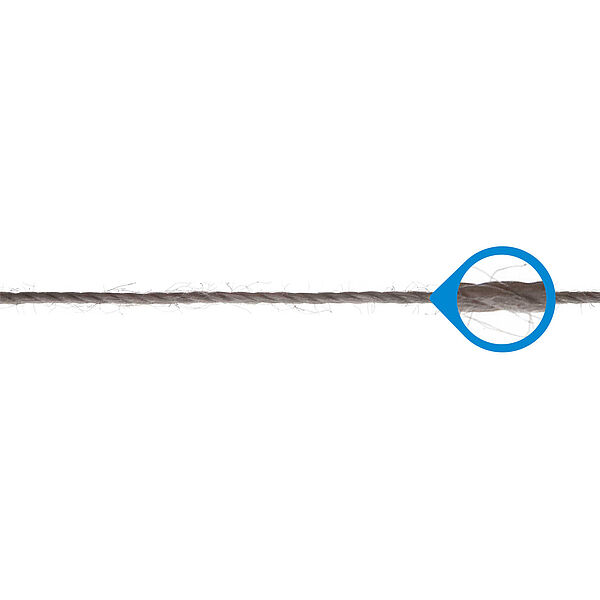
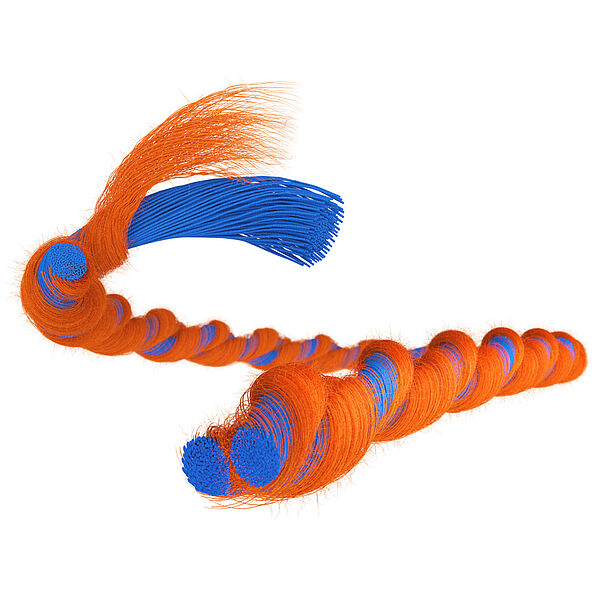
A core spun thread consists of a multifilament core surrounded by a sheath of fine fibres. The core is usually polyester, while the sheath may consist of polyester or cotton fibres. This construction combines high tear and abrasion resistance with a smooth textile surface and excellent sewability.
The polyester/polyester core spun thread Saba is one of the most important products in the AMANN range. An example of a polyester/cotton core spun thread is AMANN's Rasant.
Quick facts
| Property | Value |
|---|---|
| Category | Sewing thread construction |
| Construction principle | Multifilament core + fibre sheath |
| Typical core | Polyester multifilament |
| Typical sheath | Polyester or cotton fibres |
| Typical core/sheath ratio | Approx. 2/3 core to 1/3 sheath |
| Main variants | Polyester/polyester, polyester/cotton |
| Surface | Smooth, textile-like |
| Key properties | High tear resistance, high abrasion resistance, excellent sewability |
| Typical applications | Broad range of apparel and demanding sewing operations |
| Related constructions |
The core-to-sheath ratio can vary by application. AMANN notes that the multifilament core gives core spun threads substantially higher tear and abrasion resistance than spun threads.
Also known as
Technical terms
- Core spun thread
- Core-spun thread
- Core spun sewing thread
- Core yarn
- Core-spun yarn
- Core-sheath yarn
- Core-sheath thread
Common descriptions
People often search for:
- Thread with a filament core
- Thread with a polyester core
- Polyester core sewing thread
- Polyester/polyester core spun thread
- Polyester/cotton core spun thread
- Strong sewing thread with fibre covering
- Filament core with staple fibre covering
- What is core spun thread?
- Why is core spun thread stronger?
- Core spun vs spun thread
- What is a core yarn?
Alternative terminology
Different industries and software providers may use slightly different terminology.
- Core thread
- Core yarn construction
- Filament-core thread
- Fibre-covered core thread
- Core-and-sheath thread
International terminology
| Language | Common terminology |
|---|---|
| English | Core spun thread, Core-spun thread, Core yarn, Core-sheath yarn |
| German | Coregarn, Kern-Mantel-Garn, Nähgarn mit Filamentkern, Umspinnungszwirn |
| French | Fil à âme, Fil à âme guipée, Fil core-spun, Fil à âme multifilament |
| Italian | Filato core-spun, Filo con anima, Filato anima-guaina |
| Spanish | Hilo core-spun, Hilo con alma, Hilo de alma recubierta |
| Chinese | 包芯缝纫线, 包芯纱, 长丝芯短纤包覆线 |
| Vietnamese | Chỉ lõi, Chỉ core-spun, Chỉ lõi filament bọc xơ |
FAQ
-
A core spun thread consists of a multifilament core surrounded by a sheath of fine staple fibres. The finished strand is referred to as a core yarn.
-
The core is typically made of polyester multifilaments, while the outer sheath consists of polyester or cotton fibres. The core-to-sheath ratio is usually about two-thirds core and one-third fibre covering.
-
Polyester multifilaments provide high tensile strength and abrasion resistance, making them ideal for the load-bearing core of the thread.
-
In polyester/polyester constructions, both the core and the sheath are made of polyester. In polyester/cotton constructions, the core is polyester and the outer covering is cotton, giving the thread a more natural surface appearance.
-
The multifilament core carries most of the load, significantly increasing tear strength and abrasion resistance compared to pure spun constructions.
-
Core spun threads have a smooth yet textile surface due to the fibre sheath, combining performance with good seam appearance.
-
Yes. Their excellent sewability allows reliable processing even in multidirectional sewing operations and challenging applications such as laundry buttonholes.
-
In polyester/polyester core spun threads, the covering often consists of cut staple fibres with a length of approximately 40 mm.
-
Core spun threads are widely used in apparel, workwear, denim, shirts, trousers and general garment manufacturing where strength and processing reliability are essential.
-
Because they combine the strength of a continuous filament core with the handling and appearance advantages of a fibre covering.