
Intro
When people think about mattresses, they usually think about foam, springs or comfort layers. That's understandable—after all, these are the features most often highlighted when choosing a new mattress. Some people focus on firmness, others on pressure relief or breathable fabrics. Yet there is one essential element that rarely receives attention, despite influencing the durability and overall quality of every mattress and bedding product.
The seams.
After many years of working with bedding manufacturers, I have learned that every stitch serves a purpose. A seam is far more than a connection between two pieces of fabric. It helps stabilise materials, secures fillings, reinforces high-stress areas and contributes to the appearance of the finished product. In many ways, it is the invisible engineering behind every mattress, pillow and quilt.
Whenever I walk through a mattress production facility, I am reminded that manufacturing a bedding product is a carefully coordinated process. Every production step builds upon the previous one, and every sewing operation contributes to the performance of the final product. While consumers may never notice these details, manufacturers understand that long-lasting quality begins long before the first night's sleep.

A mattress is much more than its filling
Looking at a finished mattress, it is easy to overlook how many individual components have been brought together. Beneath the surface lies a carefully designed construction consisting of multiple layers, fabrics and structural elements, all of which need to remain securely connected throughout years of everyday use.
One of the first major manufacturing steps is quilting. At first glance, quilting appears to be a decorative feature. The stitched patterns certainly enhance the appearance of a mattress, but their purpose goes far beyond aesthetics.
Quilting secures the outer fabric to the underlying comfort layers and helps prevent filling materials from shifting over time. This creates a stable construction that maintains both comfort and appearance throughout the product's lifetime. Without this process, the materials inside the mattress could move, reducing both comfort and durability.
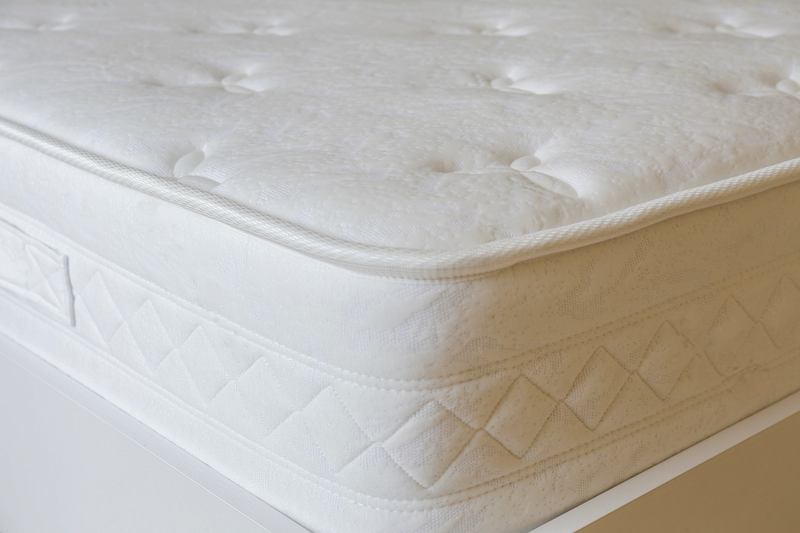
As production continues, additional sewing operations gradually transform individual components into a finished mattress. Borders are attached to connect the upper and lower panels, helping to create the overall structure of the product. Depending on the mattress design, decorative quilting may also be applied to the borders, improving both stability and visual appeal.
Many premium mattresses also include integrated carrying handles. Although they may seem like a small design feature, they are subjected to considerable mechanical stress every time the mattress is moved. Their attachment therefore requires reliable seam construction that distributes forces evenly and remains secure throughout years of handling.
Another familiar feature is the removable mattress cover. Integrating a zipper may appear straightforward, but achieving consistent alignment and smooth operation requires accurate sewing throughout the manufacturing process. Even seemingly simple components rely on precision if they are to perform reliably over time.
Finally, one of the most recognisable operations in mattress manufacturing is tape edge sewing. This process joins the upper panel, border and lower panel while creating the characteristic finished edge seen on most mattresses. Besides providing structural integrity, the tape edge also defines much of the product's visual quality. A clean, consistent tape edge immediately reflects careful manufacturing.
The same principles apply beyond mattresses
Although mattresses are the largest bedding products, the same manufacturing philosophy applies to pillows, quilts and bed linen.
Pillows may appear relatively simple, yet their seams perform an important function. They must securely contain the filling while remaining comfortable during everyday use. Consistent seam formation helps maintain the pillow's shape and contributes to long-term durability.
Quilts present a different challenge. Here, quilting serves not only as a decorative design element but also as a functional manufacturing process. By securing the filling across the entire surface, quilting helps maintain even insulation and prevents the filling from migrating during repeated use and washing. Every quilting line therefore contributes directly to the product's long-term performance.
Bed linen follows yet another approach. Since there are no filling materials to stabilise, manufacturers focus on producing clean, durable seams capable of withstanding frequent washing and everyday handling. Neat edge finishing and consistent stitch formation help ensure that bed linen maintains both its appearance and functionality throughout its service life.


Quality is built into every manufacturing step
One of the most interesting aspects of bedding manufacturing is that quality cannot be added at the end of production. Instead, it is built gradually throughout every manufacturing step.
Reliable seam construction supports durability. Consistent stitch formation contributes to appearance. Carefully controlled sewing operations improve production efficiency while helping manufacturers achieve repeatable quality across large production volumes.
These factors are closely connected. A beautifully quilted surface loses its value if seam consistency cannot be maintained. Likewise, strong materials alone cannot compensate for poorly executed sewing operations. Every stage of manufacturing contributes to the final result.
This is why bedding manufacturers place such great emphasis on process consistency. Stable production processes help ensure that every mattress, pillow or quilt leaving the production line meets the same quality expectations as the one before it.
Different products, shared objectives
Although mattresses, pillows, quilts and bed linen each fulfil different functions, they ultimately share the same manufacturing goals.
Every product should provide comfort. Every seam should perform reliably. Every manufacturing step should contribute to long-term durability while supporting efficient production.
Achieving this balance requires more than selecting suitable materials. It depends on understanding how individual sewing operations interact throughout the manufacturing process and how each seam contributes to the finished product.
For manufacturers, these details are part of everyday production. For consumers, they often remain invisible. Yet they are precisely the reason why a high-quality bedding product continues to perform year after year.
Conclusion
People rarely think about the seams when choosing a mattress or bedding product. They notice comfort, appearance and perhaps the quality of the fabric—but the sewing operations that hold everything together usually go unnoticed.
From my perspective, that is exactly what defines good manufacturing. The best sewing processes are those that remain invisible throughout the product's lifetime while quietly performing their task every single day.
Every quilting line, every border seam, every zipper and every tape edge contributes to the overall performance of the finished product. Together, these carefully executed manufacturing steps create bedding products that combine comfort, durability and consistent quality.
The next time you see a mattress, pillow or quilt, take a closer look. Behind every finished product lies a surprisingly complex manufacturing process—and every stitch tells part of that story.
FAQ
-
Mattress manufacturing involves several specialised sewing operations, including quilting, border sewing, tape edge sewing, zipper insertion and handle attachment. Each process contributes to the mattress's durability, comfort, appearance and overall product quality.
-
Quilting secures the outer fabric to the comfort layers and helps prevent the filling materials from shifting over time. In addition to improving stability, quilting also enhances the visual appearance and comfort of the finished mattress.
-
Pillows and quilts are produced using carefully controlled sewing processes that secure the filling while maintaining softness and comfort. Quilting helps keep the filling evenly distributed, while closing seams ensure durability throughout the product's lifetime.
-
Tape edge sewing is the process of joining the upper panel, border and lower panel of a mattress using a reinforcing tape. It creates a clean finished edge while improving the structural stability and durability of the mattress.
-
Seam quality directly influences the durability, appearance and long-term performance of mattresses, pillows, quilts and bed linen. Consistent stitch formation and reliable sewing processes help ensure that bedding products maintain their quality throughout everyday use.
-
High-quality bedding products require durable construction, consistent seam quality, reliable manufacturing processes and an attractive appearance. These characteristics help ensure comfort, long service life and consistent product performance.
-
Sewing operations connect and reinforce the different mattress components, helping the product withstand years of mechanical stress. Well-executed seams maintain the mattress structure, improve stability and contribute to long-lasting performance.
-
Every sewing operation has a specific function, from securing fillings and joining components to improving appearance and structural stability. Together, these manufacturing steps help produce bedding products that combine comfort, durability and reliable quality.