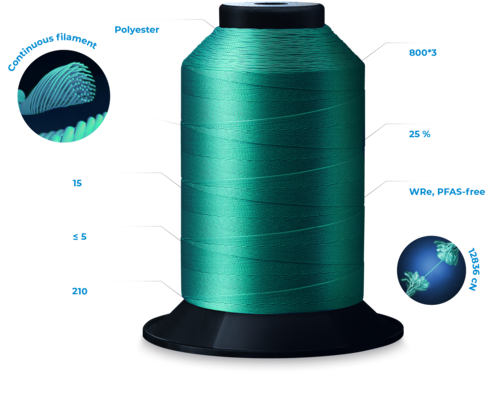
Continuous filament, braided
To produce a braided continuous filament, 12 to 16 filament yarns (continuous filament bundles) – depending on the thickness of the finished thread – are wound together…

AMANN Knowledge Hub
Our Wiki provides clear, structured and reliable technical information on sewing and embroidery threads, materials, applications and performance characteristics. Explore detailed definitions, process explanations and foundational knowledge.
To produce a braided continuous filament, 12 to 16 filament yarns (continuous filament bundles) – depending on the thickness of the finished thread – are wound together…
To produce this type of construction, continuous filaments are permanently crimped using a process known as false twisting.
In continuous filament threads, the single yarns are made from continuous fibres (filaments). In some cases, up to 200 individual filaments are combined to form a yarn…
In case of core spun threads, the single yarns consist of a core of multifilaments and a sheath of fine fibres. In sewing thread production, this finished strand is…
When it comes to the care properties of sewing threads, the quality requirement is simple: the sewing thread must meet the care requirements of the fabric. The outer…
Manufacture by thermal treatment (carbonisation) of suitable carbon-containing materials, such as polyacrylonitrile or viscose.
The seed hairs of the cotton plant are processed through various production steps to form a fibre fleece (rovings), which is then spun into a finished yarn.
Discover how thread colour influences seam appearance, visual quality, and product aesthetics in industrial sewing applications. Learn why colour consistency, matching,…
Explore how fabric type, needle size, seam requirements, and sewing applications influence the selection of the correct thread size. Learn how proper thread sizing…