Colour fastness and care of embroidery threads
Intro The colour of an embroidery thread should remain consistent throughout the intended life of the finished product. Washing, sunlight, perspiration, rubbing and…

AMANN Knowledge Hub
Our Wiki provides clear, structured and reliable technical information on sewing and embroidery threads, materials, applications and performance characteristics. Explore detailed definitions, process explanations and foundational knowledge.
Intro The colour of an embroidery thread should remain consistent throughout the intended life of the finished product. Washing, sunlight, perspiration, rubbing and…
Intro The transition towards a circular economy starts with the materials we choose and the products we develop. From recycled and bio-based materials to circular design…
Intro Climate data is becoming an increasingly important part of how products are developed, sourced and evaluated. Companies need reliable information to understand…
Learn why cleaning is an essential step in thread production to remove impurities, oils, and residues before further processing. Discover how clean yarn improves dyeing…
Explore how fabric type, needle size, seam requirements, and sewing applications influence the selection of the correct thread size. Learn how proper thread sizing…
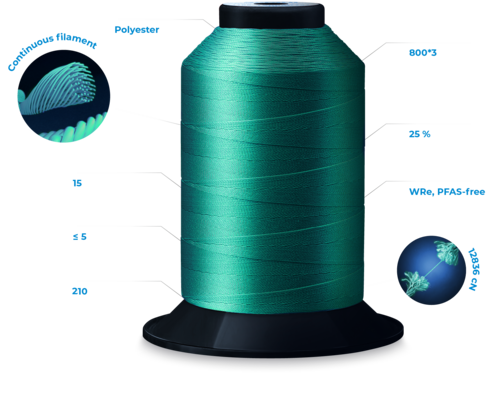
In continuous filament threads, the single yarns are made from continuous fibres (filaments). In some cases, up to 200 individual filaments are combined to form a yarn…
To produce this type of construction, continuous filaments are permanently crimped using a process known as false twisting.
To produce a braided continuous filament, 12 to 16 filament yarns (continuous filament bundles) – depending on the thickness of the finished thread – are wound together…
When it comes to the care properties of sewing threads, the quality requirement is simple: the sewing thread must meet the care requirements of the fabric. The outer…