
Intro
The construction of an embroidery thread has a significant influence on how it behaves during machine embroidery. Filament structure, twist and finishing affect thread flexibility, surface appearance and the ability to form consistent stitches.
Most conventional machine embroidery threads use a two-ply continuous-filament construction. Combined with an appropriate twist and finish, this helps achieve a uniform embroidery appearance and reliable processing.
Short definition
Embroidery thread construction describes how individual fibres or filaments are combined and twisted to form a thread suitable for machine embroidery. Together with the thread finish, the construction determines how the thread moves through the machine, lies on the material and performs during stitch formation.
Why thread construction matters in machine embroidery
During embroidery, the needle thread repeatedly passes through the needle eye and the material before becoming part of the finished stitch. This exposes the thread to friction, tension and repeated mechanical stress.
The thread construction must therefore provide a suitable balance between strength, flexibility, cohesion and surface smoothness.
For machine embroidery, the most important characteristics include:
- Flexibility: Allows the thread to lie smoothly on the embroidered surface.
- Thread cohesion: Helps prevent individual filaments or yarns from separating during processing.
- Surface structure: Influences friction, stitch appearance and the visual character of the embroidery.
- Twist stability: Supports consistent thread behaviour during stitch formation.
- Finishing: Helps the thread move smoothly through the machine and reduces processing-related stress.
Two-ply construction in machine embroidery
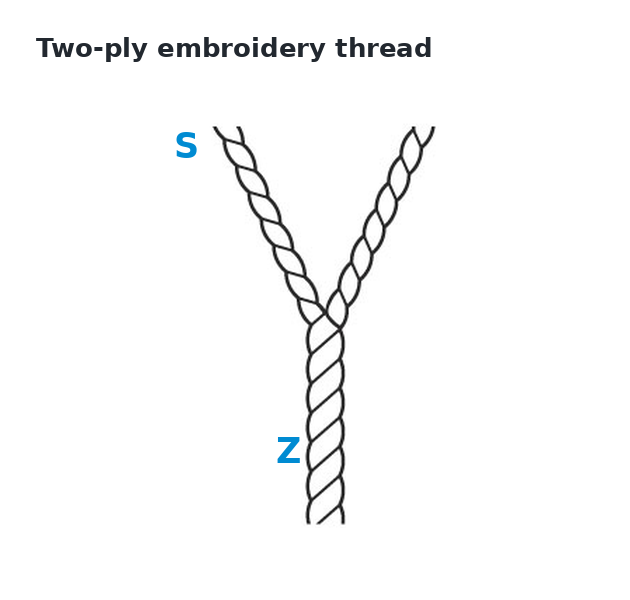
Most conventional machine embroidery threads are produced from continuous filaments combined into a two-ply construction.
Two single yarns are twisted together to form the finished embroidery thread. This construction provides good flexibility and allows the thread to lie relatively flat against the embroidered surface.
The flat character of two-ply threads is particularly advantageous in machine embroidery because it supports uniform stitch coverage and a smooth surface appearance.
Twist direction and embroidery performance
Twist is essential for keeping the individual yarns or filaments together and maintaining a stable thread structure.
Conventional machine embroidery threads generally use Z-twist in the finished thread, while the individual yarns are twisted in the opposite, S direction.
This construction is also common in sewing threads. Machine embroidery threads do not require a fundamentally different twist direction from conventional machine sewing threads.
The amount of twist is equally important:
- Insufficient twist: Can result in an open thread structure, reduced cohesion and increased sensitivity to mechanical stress.
- Excessive twist: Can create an overly lively thread that tends to curl, form loops or become difficult to process.
- Balanced twist: Supports thread stability, flexibility and reliable stitch formation.
The appropriate twist level depends on the thread thickness, construction and intended application.
Filament structure and embroidery appearance
Besides twist and ply, the shape and arrangement of the individual filaments influence the appearance of the finished embroidery.
Continuous-filament threads generally have a smooth and uniform surface. However, different filament cross-sections reflect light differently.
For example, trilobal polyester filaments provide a larger light-reflecting surface than round filaments. This contributes to the pronounced lustre of embroidery threads such as AMANN Isacord.
The interaction between filament structure, thread construction and stitch direction determines how the embroidery reflects light and how the design appears on the material.
Thread finishing and processing reliability
Thread finishing, also known as lubrication or avivage, plays an important role in reliable machine embroidery.
During production, embroidery threads receive a carefully controlled finish that improves their processing characteristics.
Finishing preparations can contain lubricating and antistatic components. Their main functions include:
- Reducing friction between the thread, needle and material
- Improving thread movement through guides and tensioning elements
- Helping manage friction and heat during processing
- Reducing electrostatic charging and associated handling problems
- Supporting consistent thread tension and stitch formation
The amount and distribution of the finish must be carefully controlled. Both insufficient and excessive finishing can negatively affect processing.
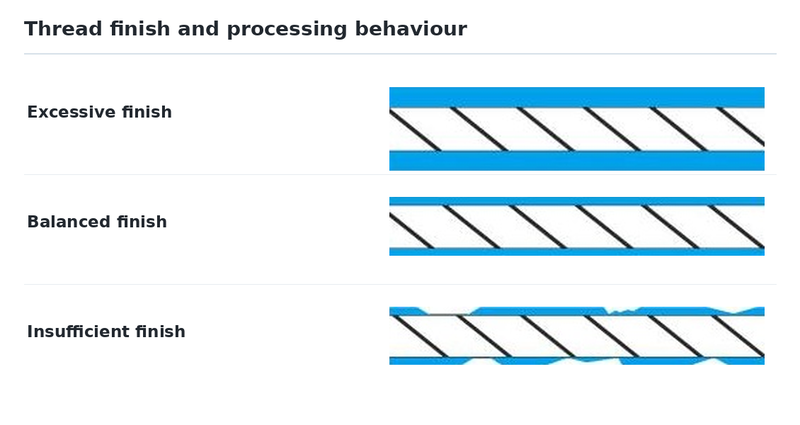
Effects of an unbalanced thread finish
| Finishing condition | Possible effects |
|---|---|
| Excessive finish | Deposits on thread guides and tension discs, contamination of machine components |
| Balanced finish | Good gliding properties, controlled friction and minimal deposits |
| Insufficient finish | Increased friction, irregular embroidery appearance, frequent thread breakage and unstable thread tension |
Recognising construction and finishing-related problems
Problems during embroidery can have several causes. Thread construction and finishing should be considered alongside needle selection, thread tension, material properties and machine settings.
Typical observations include:
| Observation | Thread-related factor to check |
|---|---|
| Frequent thread breakage | Thread cohesion, twist stability and finishing |
| Loops or excessive curling | Twist level and thread behaviour |
| Irregular stitch formation | Thread movement, friction and finishing |
| Deposits on thread guides | Excessive or uneven finishing |
| Inconsistent embroidery appearance | Thread construction, surface characteristics and processing conditions |
These observations do not automatically indicate a thread defect. The complete embroidery setup should always be checked before adjusting the process.
Choosing a suitable construction for machine embroidery
For conventional decorative embroidery, two-ply continuous-filament threads provide a suitable combination of flexibility, surface smoothness and processing reliability.
Other constructions can be used to achieve specific visual or functional effects. These may require different needles, thread tensions or embroidery parameters.
The most important consideration is that the thread construction and finishing are suitable for the intended embroidery process.
Further reading – sewing and embroidery thread technology
The general principles of yarn construction and thread manufacturing are covered in the existing AMANN Knowledge Hub:
Quick facts
| Property | Value |
|---|---|
| Category | Machine embroidery |
| Common construction | Two-ply continuous filament |
| Typical finished thread twist | Z-twist |
| Typical single yarn twist | S-twist |
| Key construction characteristics | Flexibility, thread cohesion, surface smoothness |
| Filament cross-sections | Round, trilobal and other specialised shapes |
| Filament influence | Surface appearance, lustre and processing characteristics |
| Thread finishing | Lubrication and antistatic treatment |
| Main finishing functions | Friction reduction, improved gliding properties and processing reliability |
| Possible processing problems | Thread breakage, looping, irregular stitch formation and deposits |
| Related topics | Thread materials, needle selection, thread tension and stitch formation |
Also known as
Technical terms
- Embroidery thread construction
- Machine embroidery thread structure
- Industrial embroidery thread construction
- Two-ply embroidery thread
- Two-ply filament thread
- Continuous-filament embroidery thread
- Multifilament embroidery thread
- Embroidery thread twist
- S-twist
- Z-twist
- Twist direction
- Twist level
- Thread cohesion
- Filament cross-section
- Trilobal filament
- Embroidery thread finishing
- Thread lubrication
- Thread finish
- Thread avivage
- Antistatic finishing
Common descriptions
- How are embroidery threads constructed?
- What is a two-ply embroidery thread?
- Why are embroidery threads twisted?
- What is the difference between S-twist and Z-twist?
- Why are two-ply threads used for machine embroidery?
- Why do embroidery threads lie flat on the fabric?
- What makes an embroidery thread shiny?
- How does thread construction affect embroidery quality?
- Why does embroidery thread curl or form loops?
- Why does embroidery thread break during stitching?
- Why do embroidery threads need lubrication?
- What is embroidery thread finishing?
- What causes deposits on embroidery machine thread guides?
- Does thread twist influence stitch formation?
- What happens when an embroidery thread has too much twist?
- How does thread finishing affect processing reliability?
Alternative terminology
Different markets and applications may use slightly different terminology.
- Embroidery yarn construction
- Embroidery thread structure
- Embroidery yarn structure
- Plied embroidery thread
- Double-ply embroidery thread
- Two-fold embroidery thread
- Twisted embroidery yarn
- Embroidery thread torsion
- Yarn twist direction
- Twist balance
- Filament yarn construction
- Thread surface treatment
- Embroidery yarn finishing
- Sewing thread lubrication
- Yarn lubrication
- Avivage treatment
- Thread preparation
International terminology
| Language | Common terminology |
|---|---|
| English | Embroidery thread construction, Thread twist, Two-ply embroidery thread, Thread finishing |
| German | Stickgarnkonstruktion, Garndrehung, Zweifachzwirn, Garnausrüstung, Avivage |
| French | Construction du fil à broder, Torsion du fil, Fil à broder à deux brins, Finition du fil |
| Italian | Struttura del filato da ricamo, Torsione del filato, Filato ritorto a due capi, Finissaggio del filato |
| Spanish | Construcción del hilo de bordar, Torsión del hilo, Hilo de dos cabos, Acabado del hilo |
| Chinese | 绣花线结构, 纱线捻向, 双股绣花线, 纱线润滑处理 |
| Vietnamese | Cấu trúc chỉ thêu, Hướng xoắn sợi, Chỉ thêu hai sợi xe, Xử lý hoàn tất chỉ thêu |
FAQ
-
Two-ply threads provide good flexibility and tend to lie relatively flat on the embroidered surface. This supports uniform stitch coverage and a smooth embroidery appearance.
-
S-twist and Z-twist describe the direction in which yarns or threads are twisted. Conventional machine embroidery threads generally use Z-twist in the finished thread and S-twist in the individual yarns.
-
Yes. Thread construction affects flexibility, surface smoothness and how the thread lies on the material. Filament shape also influences the reflection of light and the appearance of the embroidery.
-
Trilobal filaments provide a larger light-reflecting surface than round filaments. This helps create a more pronounced lustre in the finished embroidery.
-
Excessive twist can make the thread overly lively, causing curling, loops or processing difficulties.
-
Thread finishing improves gliding properties, reduces friction and helps control electrostatic charging. This supports reliable thread movement and stitch formation during embroidery.
-
Yes. Excessive finishing can lead to deposits on thread guides, tension discs and other machine components.
-
No. Thread breakage can result from several factors, including needle selection, thread tension, machine speed, material properties and embroidery design. Thread finishing is one factor that should be considered when investigating processing problems.