

Sewing threads for accessories
Accessories combine functionality, durability and design in often compact and highly visible products. Belts, wallets, card holders and other accessories can be exposed to frequent handling, bending, friction and mechanical stress. Sewing threads therefore need to provide reliable seam strength and sewing performance while also contributing to a clean and refined appearance.
For the applications shown on this page, AMANN recommends Serafil as the universal sewing thread in thread sizes matched to the material and seam position. Onyx can be selected for more demanding or prominent seams, while Saba is used for the lining seam shown for small leather goods.
Belts
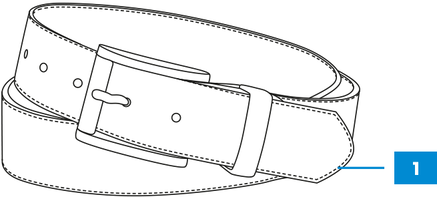
AMANN sewing thread recommendation for belts
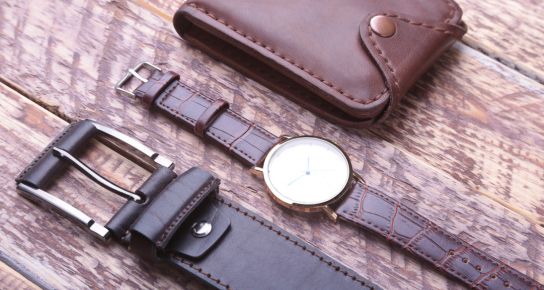
Belts are exposed to repeated bending, tension, friction and daily handling. Their seams therefore need to remain durable while visible topstitching often also plays an important role in the overall design.
For the application shown above, AMANN recommends Serafil 30 / Tex 90 as the universal sewing thread for closing and topstitch seams using a 301 lockstitch. Depending on the desired appearance and individual requirements, Serafil or Onyx can be selected in different thread sizes for decorative seams.
| Seam no. | Seam type | Stitch type | Needle thread | Bobbin or looper thread | Needle size min. Nm | Needle size min. No | ||||
|---|---|---|---|---|---|---|---|---|---|---|
| Article | Ticket no. | Tex no. | Article | Ticket no. | Tex no. | |||||
| 1 | Closing and topstitch seams | 301 lockstitch | Serafil | 30 | 90 | Serafil | 30 | 90 | 100 | 16 |
Standard thread requirement:
Depending on form and size
Small leather goods
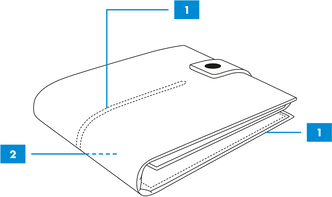
AMANN sewing thread recommendation for small leather goods
Small leather goods such as wallets, card holders and similar accessories combine compact constructions with functional and highly visible seams. Different seam positions can therefore require different thread sizes and characteristics.
For the applications shown above, AMANN recommends Serafil 60 / Tex 45 as the universal sewing thread for closing and topstitch seams. For the lining seam, Saba 120 / Tex 24 is used. All applications shown use a 301 lockstitch. Depending on the individual requirements and sewing conditions, Onyx can be selected as an alternative for closing and topstitch seams.
| Seam no. | Seam type | Stitch type | Needle thread | Bobbin or looper thread | Needle size min. Nm | Needle size min. No | ||||
|---|---|---|---|---|---|---|---|---|---|---|
| article | ticket no. | tex no. | article | ticket no. | tex no. | |||||
| 1 | closing and topstitch seams | 301 lockstitch | Serafil | 60 | 45 | Serafil | 60 | 45 | 80 | 12 |
| 2 | lining seams | 301 lockstitch | Saba | 120 | 24 | Saba | 120 | 24 | 65 | 9 |
Standard thread requirement:
Depending on form and size
Requirements for sewing threads in accessories
The sewing thread is an important part of the overall accessory construction. Depending on the product, material and seam position, requirements may include:
- high seam strength
- high abrasion resistance
- reliable performance under repeated bending and mechanical stress
- consistent stitch formation
- reliable sewing performance
- suitability for different material thicknesses
- suitability for closing, lining, topstitch and decorative seams
- an attractive appearance for highly visible seam positions
The right combination of sewing thread, thread size, stitch type, needle size, material and seam construction helps create durable and visually consistent seams for different types of accessories.
Choosing the right sewing thread for accessories
There is no single thread size or sewing parameter suitable for every accessory. The appropriate solution depends on several factors, including:
- type and intended use of the accessory
- material and material thickness
- expected mechanical load
- bending and abrasion exposure
- seam position and construction
- closing, lining, topstitch or decorative seam
- stitch type and stitch density
- required seam appearance
- thread size
- needle size
A prominent topstitch seam on a belt, for example, may require different thread characteristics from a fine lining seam in a wallet. The sewing thread should therefore always be selected according to the specific material, seam position and performance requirements.