

Sewing threads for bags
Bags have to combine durability, functionality and design. From handbags and fabric totes to backpacks and travel bags, seams can be exposed to daily handling, repeated movement, weight and abrasion. Sewing threads therefore need to provide reliable seam strength, high abrasion resistance and consistent sewing performance while also supporting the desired appearance of visible seams.
AMANN offers sewing and embroidery threads for a wide range of bag constructions and materials. For the leather bag application shown on this page, AMANN recommends Serafil as the universal sewing thread, while Saba is used for lining seams. Depending on the individual requirements, Onyx can be selected as an alternative, with Isacord and Isamet available for decorative embroidery.
Bags – from handbags to backpacks
AMANN sewing thread recommendation for leather bags
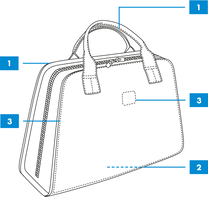
Leather bags require different thread properties depending on the seam position. Closing seams need reliable strength and durability, lining seams require a finer thread and visible topstitch seams play an important role in the appearance of the finished bag.
For the applications shown above, AMANN recommends Serafil for closing and topstitch seams. Serafil Ticket 30 / Tex 90 is used for the closing seam, while Serafil Ticket 20 / Tex 135 creates a more prominent topstitch seam. For the lining seam, Saba 120 / Tex 24 is used. All three applications shown use a 301 lockstitch.
Depending on the individual requirements and sewing conditions, Onyx can be selected as an alternative. For decorative embroidery, Isacord and Isamet provide additional design possibilities.
| Seam no. | Seam type | Stitch type | Needle thread | Bobbin or looper thread | Needle size min. Nm | Needle size min. No | ||||
|---|---|---|---|---|---|---|---|---|---|---|
| Article | Ticket no. | Tex no. | Article | Ticket no. | Tex no. | |||||
| 1 | Closing seams | 301 lockstitch | Serafil | 30 | 90 | Serafil | 30 | 90 | 100 | 16 |
| 2 | Lining seams | 301 lockstitch | Saba | 120 | 24 | Saba | 120 | 24 | 65 | 9 |
| 3 | Topstitch seams | 301 lockstitch | Serafil | 20 | 135 | Serafil | 20 | 135 | 120 | 19 |
Standard thread requirement:
Depending on form and size
Requirements for sewing threads in bags
The sewing thread is an important part of the overall bag construction. Depending on the material, bag design and seam position, requirements may include:
- high seam strength
- high abrasion resistance
- reliable performance under repeated mechanical stress
- consistent stitch formation
- reliable sewing performance
- suitability for different material thicknesses
- suitability for closing, lining and topstitch seams
- an attractive appearance for visible seams
- compatibility with decorative embroidery where required
The right combination of sewing thread, thread size, stitch type, needle size, material and seam construction helps create durable and visually consistent seams for different bag constructions.
Choosing the right sewing thread for bags
There is no single thread size or sewing parameter suitable for every bag construction. The appropriate solution depends on several factors, including:
- type and intended use of the bag
- outer and lining materials
- material thickness
- expected mechanical load
- abrasion exposure
- seam position and construction
- closing, lining or topstitch seam
- stitch type and stitch density
- required seam appearance
- thread size
- needle size
- decorative or embroidery requirements
A visible topstitch seam on a leather handbag, for example, can require a different thread size and appearance than an internal lining seam. The thread should therefore always be selected according to the specific seam position, material and performance requirements.