

Sewing threads for composites and TFP embroidery
Composite manufacturing requires precise processing of high-performance reinforcement materials such as carbon and glass fibres. In processes such as Tailored Fibre Placement (TFP), rovings are placed in defined orientations and fixed by embroidery stitches to create textile preforms for subsequent composite processing.
For these applications, AMANN recommends Serafil Comphil, a polyester continuous filament thread with a special finish developed specifically for composites. It provides optimised sewing and embroidery performance without adhesion-inhibiting properties towards the composite matrix, making it suitable for subsequent processing steps such as resin infusion.
Tailored Fibre Placement (TFP) for composites
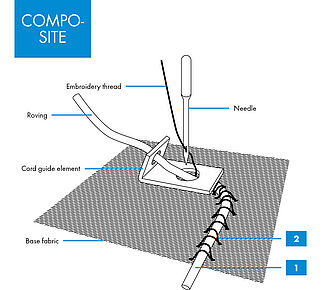
AMANN sewing thread recommendation for composites
Tailored Fibre Placement (TFP) is an embroidery-based process used to position carbon or fibreglass rovings along defined paths and fix them in place before the composite component is consolidated. This enables reinforcement fibres to be arranged according to the requirements of the finished component.
For the composite application shown above, AMANN recommends Serafil Comphil Ticket 180 (120/2) / Tex 16 for the fixing seam. A 304 zigzag lockstitch is used with Serafil Comphil as both needle and bobbin thread.
| Seam no. | Seam type | Stitch type | Needle thread | Bobbin or looper thread | Needle size min. Nm | Needle size min. No | ||||
|---|---|---|---|---|---|---|---|---|---|---|
| Article | Ticket no. | Tex no. | Article | Ticket no. | Tex no. | |||||
| 1 | Placed Roving | - | - | - | - | - | - | - | - | - |
| 2 | Fixing seam | 304 lockstitch zigzag | Serafil Comphil | 180 (120/2) | 16 | Serafil Comphil | 180 (120/2) | 16 | 65 | 9 |
Requirements for sewing and embroidery threads in composites
The thread used to fix reinforcement fibres becomes an important part of the composite manufacturing process. Depending on the fibre material, matrix system and production process, requirements may include:
- reliable sewing and embroidery performance
- compatibility with the composite matrix
- no adhesion-inhibiting properties towards the matrix
- precise fixation of carbon or fibreglass rovings
- consistent stitch formation
- suitability for TFP and preform production
- compatibility with subsequent composite processing steps
- reliable performance with the selected stitch type and needle size
The right combination of thread, thread size, stitch type, needle size, reinforcement fibre and composite manufacturing process helps ensure reliable fixation of the textile preform.
Recommended thread: Serafil Comphil
Serafil Comphil is AMANN’s special thread for composite applications. It is made from polyester continuous filament and features a special Comphil finish developed specifically for processing composites.
The finish provides optimised sewing and embroidery performance without adhesion-inhibiting properties towards the composite matrix. Serafil Comphil is therefore particularly suitable for fixing carbon and fibreglass rovings using the Tailored Fibre Placement (TFP) embroidery process.
Serafil Comphil is available in different thread sizes to meet different processing requirements. For the application shown on this page, Ticket 180 (120/2) / Tex 16 is used with a minimum needle size of Nm 65 / No. 9.
Choosing the right thread for composite processing
There is no single thread size or processing parameter suitable for every composite application. The appropriate solution depends on several factors, including:
- reinforcement material, such as carbon or glass fibre
- composite matrix system
- preform construction
- TFP or other textile processing method
- roving size and arrangement
- stitch type and stitch density
- thread size
- needle size
- subsequent processes such as resin infusion
- requirements of the finished composite component