

Sewing threads for heat and flame protective clothing
Heat and flame protective clothing places exceptional demands on seams and sewing threads. Garments used in high-temperature environments and emergency services require seam constructions that remain reliable when exposed to heat, flame and high mechanical stress.
AMANN offers specialised sewing threads for these demanding applications. K-tech is designed for applications with high requirements for cut, flame and heat protection, while N-tech and N-tech CS are particularly suitable for flame-retardant and heat-protective applications such as firefighter uniforms.
Aluminized heat protective suits
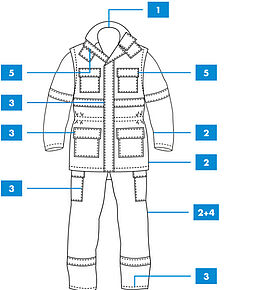
AMANN sewing thread recommendation for protective clothing
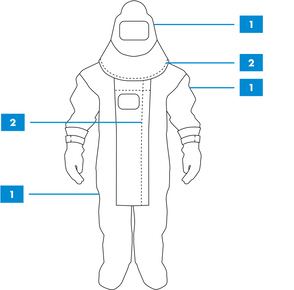
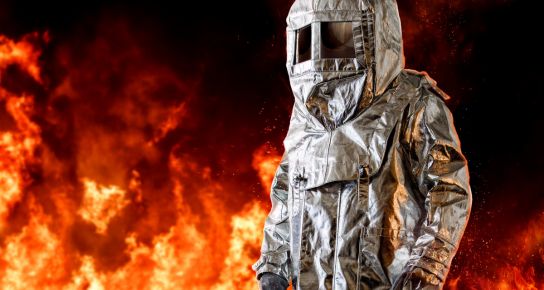
Aluminized heat protective suits are used in environments with intense radiant heat, for example in metal processing, foundries and other high-temperature industrial applications. Their reflective outer material helps protect the wearer from radiant heat and molten metal splash.
The seams used in these garments must withstand demanding thermal and mechanical conditions. For the application shown above, AMANN recommends K-tech, a para-aramid special sewing thread developed for applications with high requirements for cut, flame and heat protection.
| Seam no. | Seam type | Stitch type | Needle thread | Bobbin or looper thread | Needle size min. Nm | Needle size min. No | ||||
|---|---|---|---|---|---|---|---|---|---|---|
| Article | Ticket no. | Tex no. | Article | Ticket no. | Tex no. | |||||
| 1 | Closing seams | 301 lockstitch | K-tech | 50 | 60 | K-tech | 50 | 60 | 110 | 18 |
| 2 | Topstitch seam | 301 lockstitch | K-tech | 35 | 80 | K-tech | 35 | 80 | 120 | 19 |
Firefighter uniforms
AMANN sewing thread recommendation for firefighter uniforms
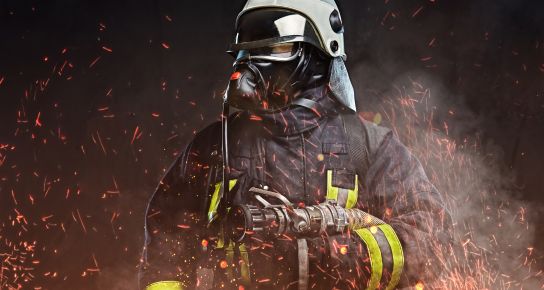
Firefighter uniforms require reliable seam constructions that can withstand demanding conditions involving heat, flame, movement and mechanical stress.
For the applications shown above, AMANN recommends N-tech as the general sewing thread. N-tech CS is used for selected seams and offers flame-retardant and heat-protective properties based on meta-aramid fibres. Both products are self-extinguishing and non-melting.
| Seam no. | Seam type | Stitch type | Needle thread | Bobbin or looper thread | Needle size min. Nm | Needle size min. No | ||||
|---|---|---|---|---|---|---|---|---|---|---|
| Article | Ticket no. | Tex no. | Article | Ticket no. | Tex no. | |||||
| 1 | Closing and topstitch seams | 301 lockstitch | N-tech | 70 | 40 | N-tech | 70 | 40 | 80 | 12 |
| 2 | Closing seams | 401 double chainstitch | N-tech | 70 | 40 | N-tech | 70 | 40 | 80 | 12 |
| 3 | Topstitch seams | 301 lockstitch | N-tech | 40 | 75 | N-tech | 70 | 40 | 100 | 16 |
| 4 | Serging seams | 504 3-thread overlock stitch | N-tech CS | 120 | 25 | N-tech CS | 120 | 25 | 70 | 10 |
| 5 | Bar tack | 304 lockstitch | N-tech | 70 | 40 | N-tech | 70 | 40 | 80 | 12 |
Requirements for sewing threads in heat and flame protective clothing
The sewing thread is an integral part of the overall protective garment construction. Depending on the application, material and intended use, requirements may include:
- high seam strength
- resistance to heat and flame
- high mechanical strength
- abrasion resistance
- reliable sewing performance
- compatibility with the selected protective textile
- reliable performance with the selected stitch and seam construction
The right combination of sewing thread, stitch type, needle size and textile construction helps achieve reliable and consistent seams in demanding protective clothing applications.
Recommended sewing threads for protective clothing
K-tech is a para-aramid special sewing thread for applications with high requirements for cut, flame and heat protection. It offers permanent temperature resistance up to approximately 170°C, with a decomposition temperature of approximately 425°C. Its burning behaviour is tested according to DIN EN ISO 15025.
N-tech and N-tech CS are meta-aramid sewing threads developed for flame-retardant and heat-protective applications. Both are self-extinguishing and non-melting, offer permanent temperature resistance up to approximately 200°C and have a decomposition temperature of approximately 370°C. Their burning behaviour is tested according to DIN EN ISO 15025.
Choosing the right sewing thread for protective clothing
There is no single sewing thread or sewing parameter suitable for every protective garment. The appropriate solution depends on several factors, including:
- type of protective garment
- textile material and construction
- thermal exposure
- mechanical requirements
- seam construction
- stitch type and stitch density
- thread size
- needle size
- required protective properties
- Frequently asked questions
- What sewing thread is suitable for heat protective clothing?